Tote Pick and Place
What Does This Robot Do?
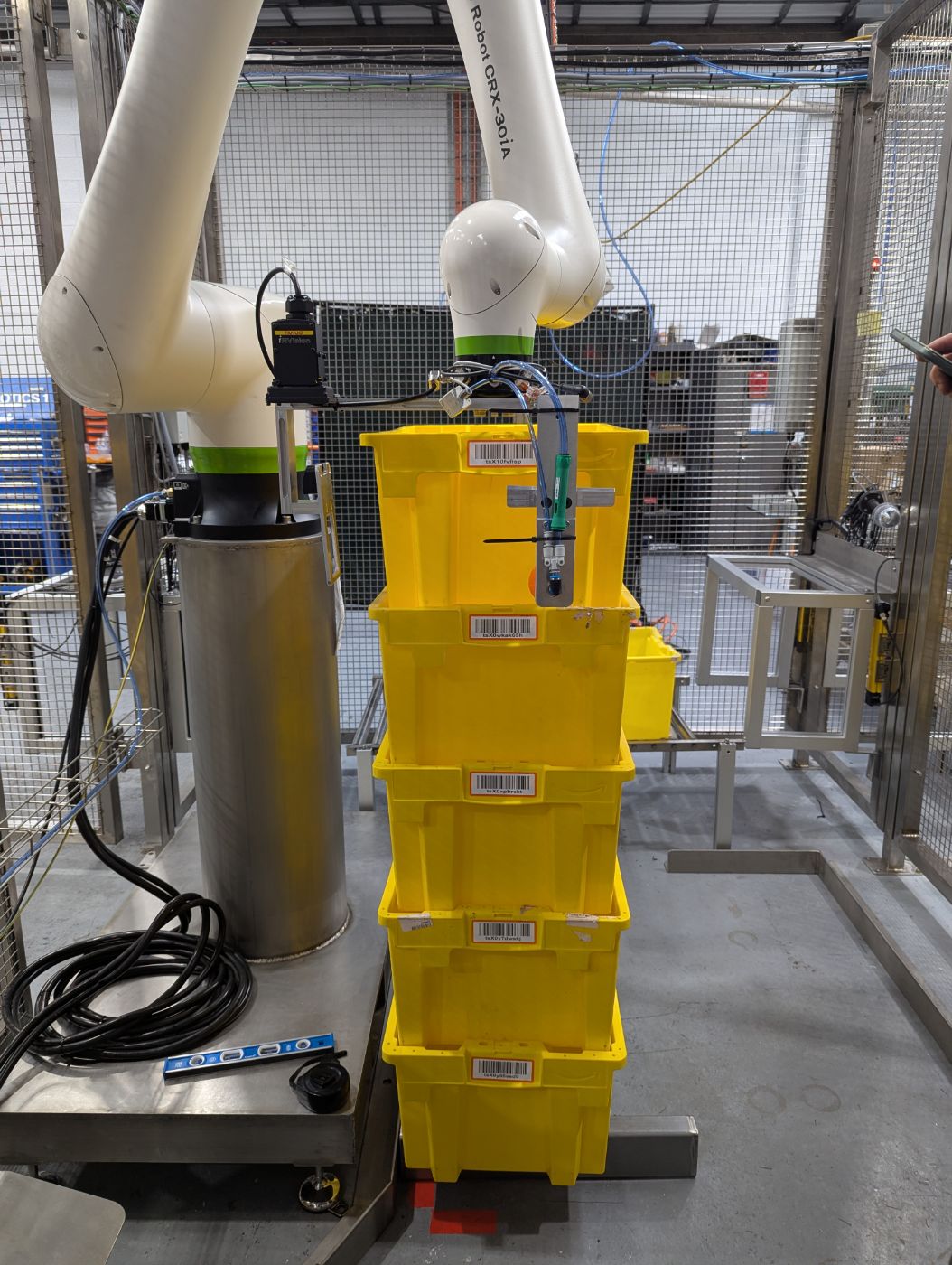
This is a pick and place robot: it picks totes from a pallet and places them onto a conveyor for downstream sortation or processing, a core “first step” in many automated fulfilment and distribution operations. Rather than a single robot doing one job, this is a dual-cell architecture, with two robotic cells working off a shared conveyor to keep pace with a high-throughput line.
The Challenge
Pallets of totes arrive without perfectly consistent stacking. Totes shift slightly during transport, layer heights vary pallet to pallet, and the system needs to figure out the layer pattern and orientation itself rather than being told in advance. On top of that, two robotic cells were sharing a single outfeed conveyor, which meant the timing logic for placing a tote had to account for what the other cell was doing, not just its own state. And because this sits in a high-traffic area with constant pallet changeovers and maintenance access, the safety architecture had to allow people to safely enter and exit each cell without halting the rest of the line.
The Solution
Each robot starts a pallet by scanning across the top layer to work out tote orientation and layer height before picking begins, rather than relying on a fixed, pre-taught position. Per tote, the robot uses a tool-mounted vision camera to pattern-match the tote and calculate its precise pickup position, backed by an ultrasonic sensor to confirm a tote is actually present and a proximity switch to measure pallet height variation once per pallet. Gripping uses a wedge that slides under the tote’s handle combined with a vacuum cup against the tote wall, giving a secure hold without needing a mechanical clamp. Placement onto the conveyor is gated by photoelectric sensors and a configurable “conveyor clear” delay, so totes from either cell are never placed into a clash. The whole cell sits inside a layered safety system: light curtains, an area scanner, a muting tunnel for tote pass-through, and an interlocked maintenance access door, so operators can safely enter for pallet changeovers without stopping the line.
The Result
The combination of vision, ultrasonic, and proximity sensing means the system makes a confirmed pick decision rather than a single-point-of-failure guess, which keeps unplanned stoppages low even with natural variation in incoming pallets. Running two cells off a shared conveyor with coordinated timing logic effectively doubles throughput without doubling the downstream conveyor infrastructure, a pattern we can apply anywhere a single robot would otherwise become the bottleneck on a high-volume line.