Efficiency & Speed
Immediate savings on your investment
Saves serious money on labour, with cycle times that earn the investment back fast.
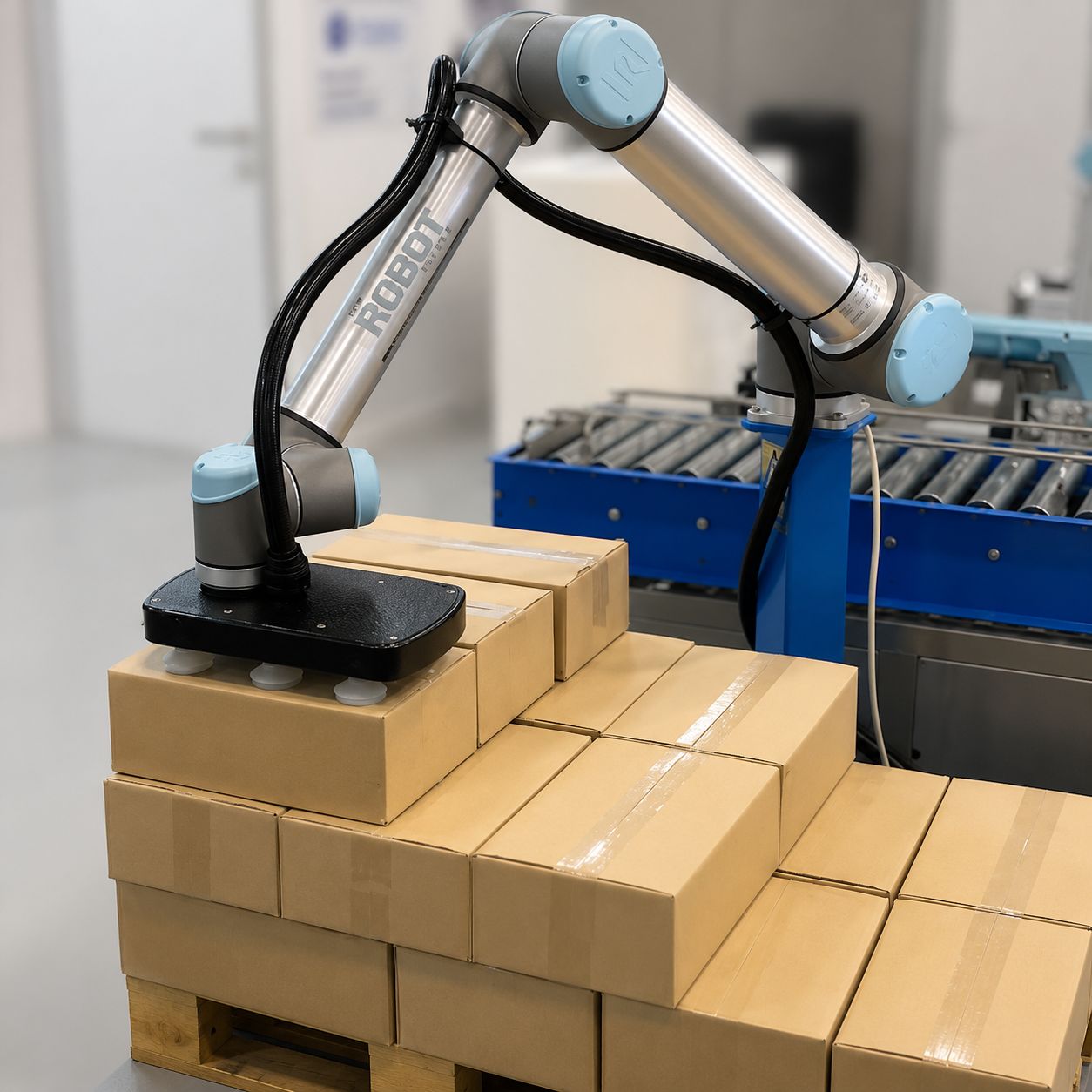
Tired of lifting boxes? A collaborative palletising system stacks your product consistently, safely and around the clock, earning back your investment faster than you'd think.
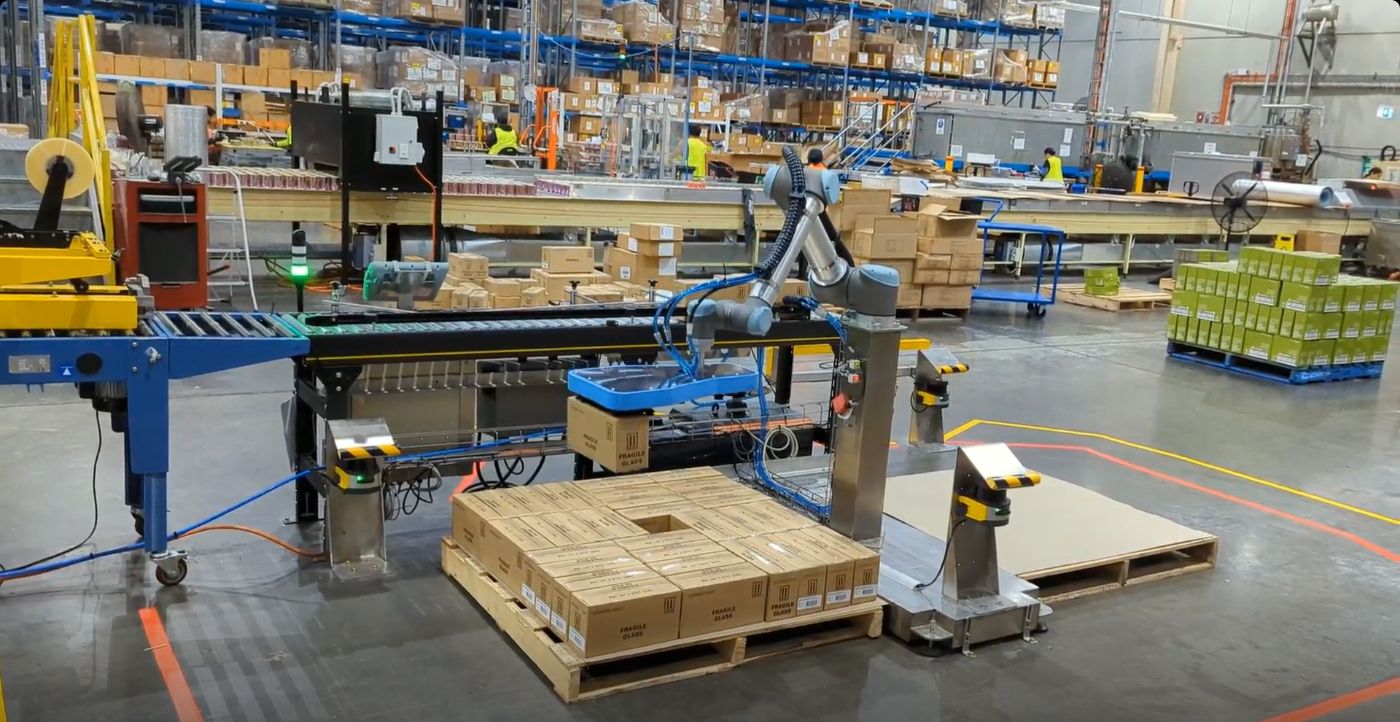
Our Universal Robots palletising system is fully customisable to your requirements. It comfortably handles a wide variety of sizes, shapes and weights, and can serve single or multiple production lines at the same time.
Want to learn more about other projects?
The collaborative robot arm at the heart of the cell, safe, flexible and proven across Australian manufacturing.

World-leading palletising software with a simple touch-screen interface, build new pallet patterns in minutes.

A robust lift column that extends the cobot’s vertical reach so it can build full-height pallets with ease.
A conventional industrial palletiser works behind fixed guarding. A TRP cobot palletiser uses programmable Category 3 area scanners instead, which keeps the space around the cell open for your team.
With no fixed guarding, operators have open access around the cell for pallet changes and day-to-day work.
When someone approaches the cell, for example to replace a full pallet, the scanners slow the robot down.
If a person comes closer, the robot comes to a safety stop and is restarted with a push-button reset.
Cells are designed to comply with Australian Standards for collaborative robots, with support from our Certified Machine Safety Expert.
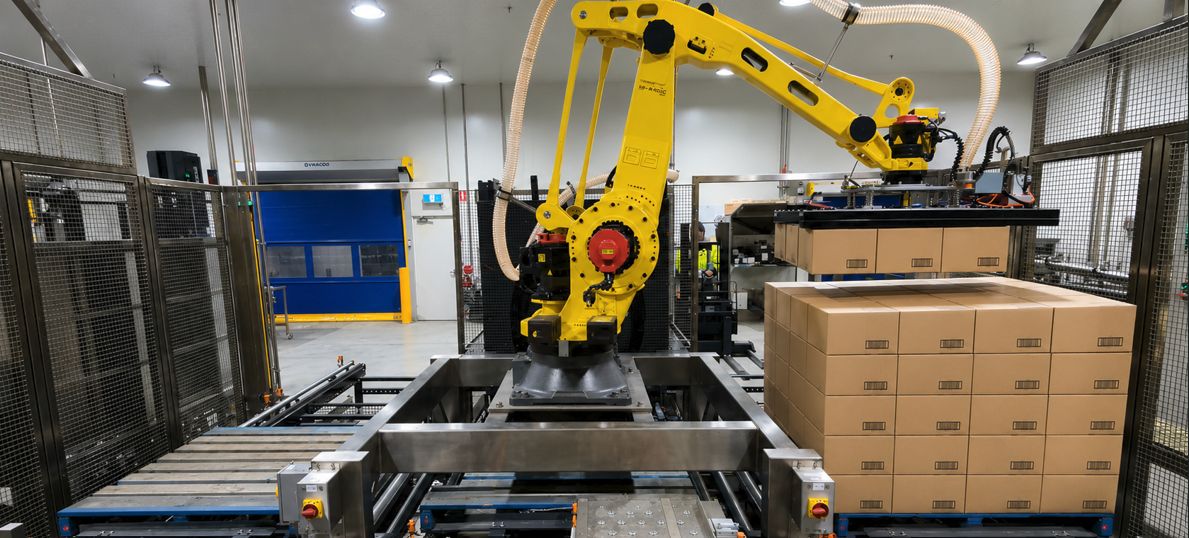
The same collaborative system can unload pallets just as easily as it builds them, feeding product onto your line without the manual handling, the strain injuries or the downtime. One cobot, both ends of the process.
The right palletiser depends on your product and your line. These are the factors we look at first. New to cobots? Start with our guide to collaborative robots.
Each palletiser is built around the palletising robot that suits your heaviest case and tallest pallet. These are the typical figures for the models we use most.
| Specification | UR20 | UR30 | FANUC CRX-30iA |
|---|---|---|---|
| Max payload (incl. gripper) | 20 kg | 30 kg | 30 kg |
| Reach | 1750 mm | 1300 mm | 1900 mm |
| Cases per minute | Typically 8–12 single picks per minute; higher with multi-pick grippers | ||
| Max pallet height | Up to approx. 2.0 m with a lift column, depending on model and case size | ||
| Footprint | Freestanding frame with one or two pallet stations; drawn into your layout before you buy | ||
| Power / air | Standard power supply and factory compressed air; the vacuum pump is built into the cell | ||
Typical figures. Throughput and pallet height depend on case weight, pattern and gripper, and we confirm them against samples of your product before quoting.
Buy a robotic palletiser outright on a fixed-price proposal, or rent a palletising robot to prove the return on your own line before you commit. Rental units are configured for your product and can be converted to a purchase.
No traditional fixed guarding is needed. Programmable Category 3 area scanners slow the robot when someone approaches and bring it to a safety stop if they come closer, with a push-button reset to restart.
Yes. The cell is not bolted down, so it can be moved to another line with a pallet jack or forklift.
Power and factory air. The vacuum pump that drives the gripper is part of the cell.
Yes. A cobot can also lift cartons off a pallet onto a conveyor, as covered in the depalletising section above and in our Teralba palletising and depalletising project.
Yes. You can rent a cobot and see it working before committing to a purchase.
Boxes and cartons, sacks and bags, bottles, trays, crates and bundles. The carbon fibre gripper has multiple vacuum zones so it can pick different box sizes.
Before you buy, we analyse your current line rate to confirm the cobot can match it, draw the cell into your layout and test with samples of your product.
Our proposals are fixed-price and include design, build, programming, freight, commissioning and training.
It depends on what the cell has to do. The main cost drivers are the robot model and payload, the gripper, whether you run one or two pallet stations, whether a lift column is needed for taller pallets, the infeed conveyor, the number of products and pallet patterns, and the safety scanning. We price every robotic palletiser as a fixed-price proposal covering design, build, programming, freight, commissioning and training, so you know the full cost up front. If you would rather start smaller, renting a palletising robot spreads the cost and lets you prove the return first.